
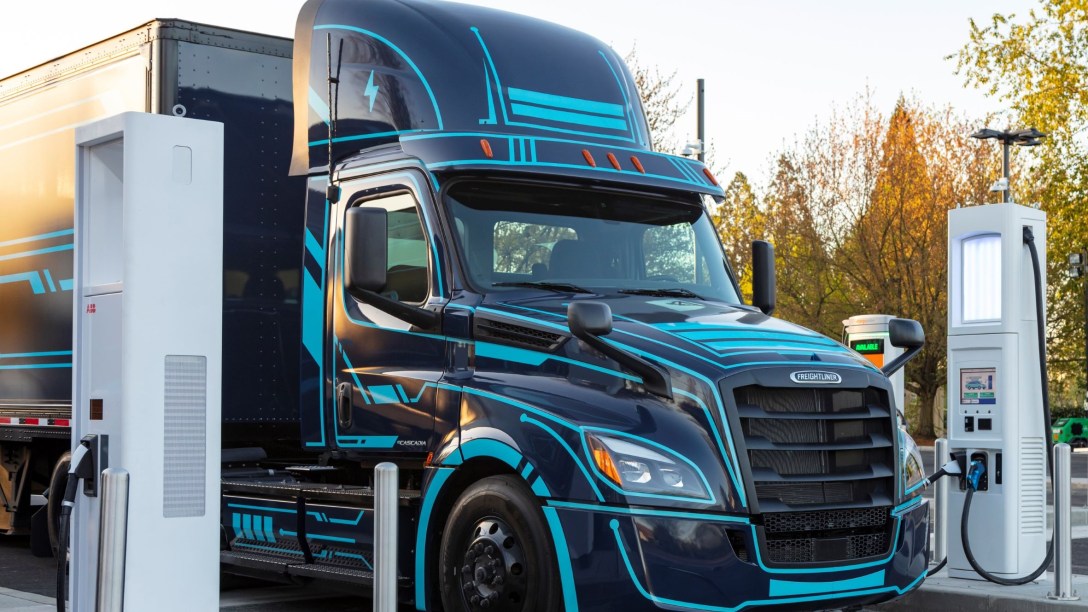
Barcelona, August 24, 2023.- Charging electric freight trucks is a business. At least, this is how real estate companies in America are seeing it:
According to information published by Freight Waves magazine, every electric charging depot needs land. As part of a multiprong strategy, the biggest real estate developers and a host of well-funded startups are gobbling up acreage for future sites.
The opportunity is enormous. The California Energy Commission estimates the state will need 157,000 medium- and heavy-duty truck chargers by 2030. The first target is the 30,000 drayage trucks that haul cargo to and from ports in Los Angeles, Long Beach and Oakland.
California passed the Advanced Clean Trucks and Advanced Clean Fleets regulations requiring a transition from diesel to electricity. Generous incentives for buying electric trucks, installing charging stations and building utility infrastructure lessen the enormous cost burden along with credits under the state’s Low Carbon Fuel Standard.
“We will take that hodgepodge of incentives and turn it into a digestible monthly fixed fee for a trucker,” said Matt LeDucq, CEO of Fourm Mobility, a startup backed by global real estate services leader CBRE.
Large fleets saw California’s rules coming. Schneider recently opened a 4.8-megawatt charging facility in El Monte, east of Los Angeles. It is capable of charging 32 Class 8 trucks at one time. NFI Industries expects to bring a similar facility online in Ontario later this year. Both facilities are private, though they received significant financial help from state and local governments.
“The depot we’re building in Livermore is going to be accessible to people who don’t have land and don’t have charging infrastructure,” said LeDucq. His company is working on 10 drayage-focused charging sites across the state. “There are a lot of little fleets out there.”
Forum has plenty of competition. Startup WattEV opened its first public charging depot at the Port of Long Beach in July. It expects to open three more sites before the end of the year. It offers a truck-as-a-service model, allowing drivers to use WattEV-owned trucks and charging for a single price. WattEV largely relies on grants and incentives.
It recently received a $34 million federal grant through the California Transportation Commission to build and operate what is expected to be the nation’s largest electric charging depot. It would cover more than 100 acres near Sacramento International Airport on Interstate 5.
By contrast, startup infrastructure developer Voltera Inc. is backed by EQT, one of the largest and most active infrastructure investors globally. Its biggest announcement so far is cooperating with Nikola Corp. to add up to 50 Hyla hydrogen filling stations to its battery-electric charging sites.
Daimler Truck North America is working with BlackRock Alternatives and NextEra Energy Resources on a $650 million electric charging plan called Greenlane. Its first site will be in Southern California followed by additional sites along various freight routes.
The largest real estate services company in the world, CBRE sees parallels between its business and electric vehicles.
“It’s akin to running a data center or running a building management system,” said Scott Howard, CBRE executive managing director and EV Solutions lead. “It’s something we’re uniquely positioned to do for the industry.”
CBRE’s client roster includes office buildings, industrial and manufacturing facilities, and distribution yards. Customers began asking how to electrify their fleets before it formalized the EV Solutions business unit.
“The definition of real estate is broader than just the building,” Howard said.
CBRE leads a $400 million joint venture with Forum Mobility, focused on winning new customers.
“We obviously have a very large and deep client roster. There’s a lot of need from them to electrify their campuses [and] their fleets,” Howard said. “The industry is just exploding.”
Long relationships with utility providers is another advantage, according to Jim Hurless, CBRE global real estate lead for EV business.
“We approach it together not just to solve for this one facility but understanding what CBRE’s client base is or the REITs [real estate investment trusts] and other investors and developers that we partner with. What is their strategy for the same market in the same area in the grid? We have the ability to give them a forward-looking forecast.”
As of December, Prologis owned 5,495 buildings, many of them warehouses, comprising about 1.2 billion square feet in 19 countries.
“By 2030, depending on the market, we’re going to see a reasonably substantial portion of those sites electrified,” said Henrik Holland, senior vice president and global head of Prologis Mobility.
“We have direct access to the warehouses where our customers are charging. Charging will happen where it’s most cost effective and operationally efficient. In many cases, that’s going to be [behind the fence] at the logistics facility.
Prologis has two such projects with A.B. Moeller Maerk’s Performance Team drayage operation. One is a Prologis-owned warehouse where Prologis provides the charging infrastructure to manage the Performance Team’s charging needs. At a second site, Prologis operates the infrastructure but doesn’t own the building.
Such a mix of projects is how electric charging will likely develop, Holland said.
Like CBRE, Prologis is tight with utilities. That doesn’t help when equipment like switchgear is in short supply. But it does allow for keeping customers informed in real time. Using zero-carbon renewable natural gas-powered mobile chargers is a stopgap while waiting for permanent infrastructure to be constructed.
“We can bring that to life within a matter of weeks and run that for a period of time as we bring the next phase of service online with a utility,” he said.
Information, and Photo, by Freight Waves
- IRU: Current Analysis of European Transport
- “The era of playing it safe is over”
- Autonomy remains an aspiration more than a reality: Only 4% of firms surveyed aim to achieve full autonomy
- Heatwave reduces load levels on navigable rivers in Europe
- Robotic last-mile deliveries will be a short-term success?
- Current analysis: “57% said that their companies had experienced supply shortages over the last year”
- McKinsey & Company: “Increasing supply chain agility”
- “AI is now the leading cybersecurity concern for security and IT leaders”
- “Integrating real-time monitoring and predictive tools within logistics processes is catching on”
- IRU: 3.4 million drivers will retire by 2029
- France proposes new fee on cheap online orders from Temu and Shein
- Ecommerce: key obstacles in last-mile delivery
- How to Make the Supply Chain More Cost Efficient
- IRU: only 6.5% of truck drivers are under 25 years old, while the number of professionals over 55 continues to increase
- A report from the World Economic Forum and Kearney highlights the global shift towards regionalisation, resilience, digitalisation, and sustainability in supply chains

 Transportation & Logistics Software