
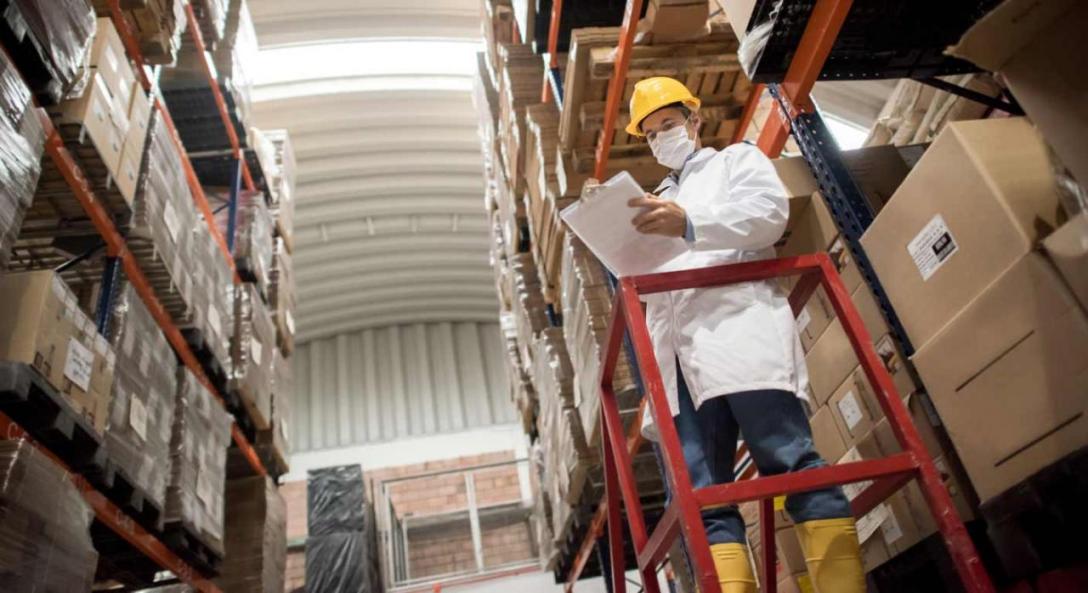
Barcelona, June 25, 2020.- Supply chains are adapting to the Post Covid era19. To an unprecedented situation in which for 3 months the supply and demand of the world market has been paralyzed. Now he begins to wake up in the midst of great uncertainty every minute. Logistics and transportation professionals work Monday through Sunday to design new strategies. And information management will be essential in any solution. A data management that has one of its main protagonists in the warehouse. We have read in Warehousing logistics international the following analysis that will surely be very useful to you.
Findings from a new white paper published by warehouse space strategists, Bis Henderson Space, suggest that logistics professionals will be seeking to create supply chains that are far more flexible, resilient and better suited to the ‘new reality’ that emerges from the Coronavirus crisis. The report, ‘Warehouse Space: A New Strategy For A New Reality’ outlines the present challenges for distribution networks, looks to future implications for supply chains and sets out an intelligent strategy for managing inventory deployment in a risk adverse world.
Steve Purvis, Operations Director at Bis Henderson Space and author of the report says: “COVID-19, the associated lock-downs, and the double hit to both supply and demand, has challenged supply chains and distribution networks in ways unprecedented in the history of advanced economies. Some have stepped up to the plate in remarkable style, others are scrabbling to find workable solutions, and some of course have simply collapsed.”.
The white paper highlights the widespread disruption across all supply chain activities, from sourcing, through transport and distribution, to the adoption of safe working practices. A common factor for many supply chains has been radical change in retailers’, manufacturers’ and shippers’ requirements for warehousing and warehouse-related activities. In some cases sales activity has slowed to a standstill and firms need somewhere to de-stuff containers and store goods that are still coming in from suppliers. In other sectors, such as health and groceries, demand has soared. However, the need to maintain safe distances between workers while increasing throughput has raised the requirement for floor-space even further.
The report reveals how global sourcing and supply chain thinking is in a state of flux. “Indications are that businesses may well be considering a reversal of thinking on running lean supply chains with low inventory cover,” says Purvis. “This is likely to lead to increased levels of inventory being held over the long-term, with a subsequent upsurge in demand for warehouse space.”
Critically, the white paper highlights an apparent lack of vision on planning future space needs. “Amid the frenzied acquisition of warehouse space, it is hard to discern much implementation of deep, pre-existing, strategy,” says Purvis. “And that is strange as, although the combination of depth, reach and scale of the COVID-19 impact is certainly unprecedented, supply chain shocks are very common.”
The paper points out that, beyond natural disasters, circumstances impacting warehousing requirements often have a more human element. ‘Preparation for Brexit’ has become a regular event, rather than the one-off that most businesses anticipated. There is also the Black Friday phenomenon.
Purvis says, “Inevitably, post COVID-19 businesses will be looking to build far greater resilience into their supply chains. This will call for greater flexibility, enhanced agility and most likely, higher levels of inventory in the network.”
The report asks two important questions: How should this inventory be managed? And, is there a cleverer way of flexing storage capacity with demand, improving efficiency and customer service, while keeping costs to a minimum?.
An alternative strategy
The white paper offers an alternative strategy to current common practice. That is to significantly lower the ‘core capacity’ of in-house or 3PL warehousing, and accept that coping with peaks, whether predicted or not, is far from an ‘emergency’ but a normal way of operating. Purvis says that for many, ‘core’ or ‘steady state’ inventory is a decreasing proportion of the whole: much more is falling into the unpredictable, higher risk segment and that has a big impact on warehousing strategy.
“The approach needed for the ‘new normal’ requires access to a range of sites, suitable in terms of size, location, duration of availability, access to labour, IT and other facilities,” says Purvis. “Working in a collaborative way with partners offers a huge potential to reduce risk and build in resilience, whilst keeping costs to a minimum. Businesses that win out will take a strategic approach to utilising flexible storage space on a planned, on-going and coordinated basis, creating a continuous dynamic buffer that flexes with the business.”
Details of how the warehouse space market is changing and how to get the most from it, is outlined in the full white paper, ‘Warehouse Space: A New Strategy For A New Reality’, which is available to download free here: https://bit.ly/3e4irhu Steve Purvis is Operations Director at Bis Henderson Space.Contact Steve at: steve.purvis@bis-henderson.com or visit www.bis-hendersonspace.com
Useful links:WarehousingTransport
Steve Purvis, Operations Director at Bis Henderson Space and author of the report says: “COVID-19, the associated lock-downs, and the double hit to both supply and demand, has challenged supply chains and distribution networks in ways unprecedented in the history of advanced economies. Some have stepped up to the plate in remarkable style, others are scrabbling to find workable solutions, and some of course have simply collapsed.”.
- IRU: Current Analysis of European Transport

- “The era of playing it safe is over”

- Autonomy remains an aspiration more than a reality: Only 4% of firms surveyed aim to achieve full autonomy
- Heatwave reduces load levels on navigable rivers in Europe

- Robotic last-mile deliveries will be a short-term success?

- Current analysis: “57% said that their companies had experienced supply shortages over the last year”
- McKinsey & Company: “Increasing supply chain agility”
- “AI is now the leading cybersecurity concern for security and IT leaders”
- “Integrating real-time monitoring and predictive tools within logistics processes is catching on”

- IRU: 3.4 million drivers will retire by 2029

- France proposes new fee on cheap online orders from Temu and Shein

- Ecommerce: key obstacles in last-mile delivery
- How to Make the Supply Chain More Cost Efficient

- IRU: only 6.5% of truck drivers are under 25 years old, while the number of professionals over 55 continues to increase

- A report from the World Economic Forum and Kearney highlights the global shift towards regionalisation, resilience, digitalisation, and sustainability in supply chains

- Is it true that tenders are undergoing a major transformation?
- Enthusiasm for AI Grows
- Gartner: the biggest Supply Chain tech trends of 2025
- Big Data in Road Planning and Management

- “Tariff volatility is now a permanent factor in supply chain strategy”
- Why Demand Planning Matters More Than Ever
- “Escalating tariffs could send supply chains into further disarray”

- Supply Chain Movement: “The quest to apply AI”

- IRU: The european road freight rate development benchmark (Q4 2024)
- McKinsey: Resilience pulse check

- How to implement agility in your supply chain, today, by 2025?
- Gartner Top 10 Strategic Technology Trends Report
- The challenges to good data management
- El transporte de mercancías cerrará 2024 con el mejor dato desde hace más de una década
- The 5 biggest challenges facing supply chain managers in 2025

 Transportation & Logistics Software