
Barcelona, November 15, 2020.- Alibaba, together with Amazon, is one of the technological giants of electronic commerce, today and tomorrow. Its logistics innovations are of interest because they advance future processes in transportation and the supply chain. The Economist has published the following report on the logistics operator Alibaba.
The Economist: Demand forecasting is one of the main drivers of efficiency within Cainiao’s logistics network, especially during massive online retail events. Instead of stocking every purchasable item across more than 230 warehouses or shipping items out only after a confirmed purchase, the Alibaba logistics affiliate, Cainiao, engages machine learning and predictive analytics to pre-stock specific popular items days, or even weeks, in advance.
Multi-faceted big data from specific geographic locations, when combined with online interactions, can show purchasing behaviours based on time, events and conditions across different customer profiles and segments. These insights empower the merchants and help to predict what and how much goods to pre-stock in certain warehouses based on their proximity to the customers to further shave off delivery time.
This data-based predictive system leads to faster, more efficient inventory turnover and reduces shipping cost and time. Demand forecasting has proven to be accurate enough to work not just at the country level, but down to the province level in China as well.
Here on, Cainiao’s cross-border parcels are all managed by the Global Smart Delivery Platform (GSDP), a technology platform that integrates the entire value chain from merchants, warehousing and dispatch to international shipping and last-mile delivery partners and personnel.
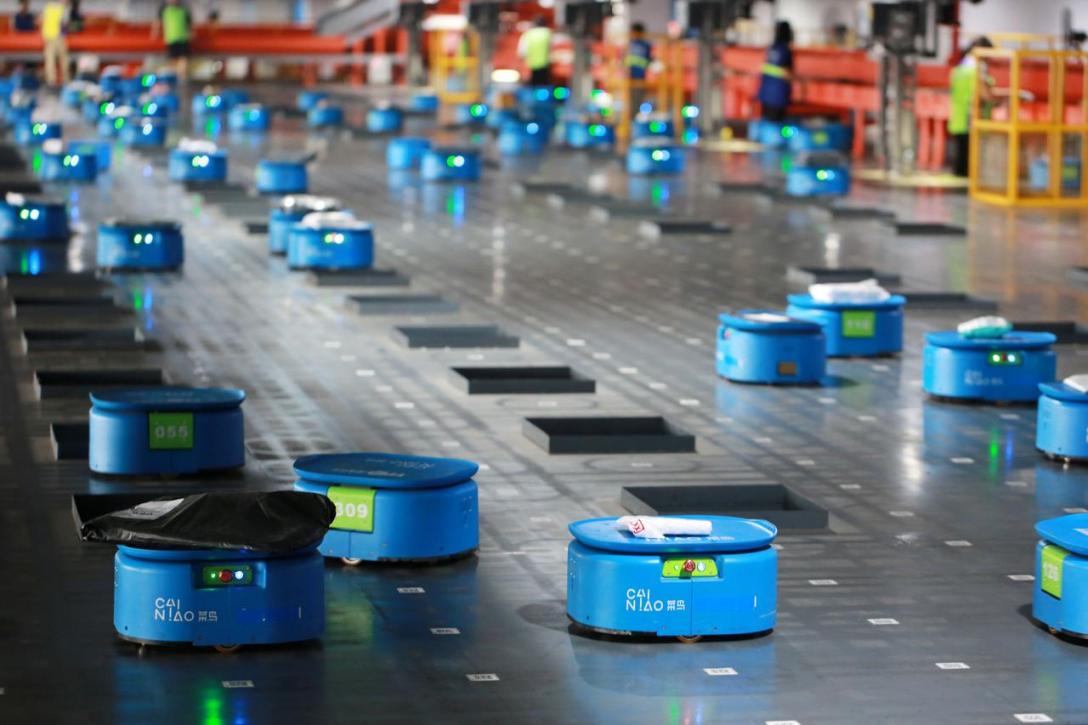
Cainiao’s smart warehouses operate with unprecedented efficiency thanks to the adoption of the Internet of Things (IoT), which streamlines operations and enables automated guided vehicles (AGV) and staff to work together seamlessly. Each warehouse features about 500 AGVs that help to move parcels for warehouse employees, who then carry out relevant sorting and distribution.
These self-driving vehicles save warehouse staff about 50,000 footsteps each day, thus increasing efficiency by 30%. Each warehouse staff is also armed with an IoT-enabled device that tags, scans and tracks all incoming and outgoing items quickly—even the missing ones—throughout the warehouse in real time.
Each outgoing parcel is then affixed with an e-shipping label, which allows Cainiao’s network of over 3,000 logistics partners to accurately track millions of deliveries across the entire logistics value chain, from first and last mile to cross-border shipments.
In China, Cainiao has achieved a shipping accuracy of 99.9+%, which translates to US$100 million in cost savings annually. Cainiao has also partnered with 30 customs clearance facilities and adopted various digital customs clearance solutions to facilitate cross-border deliveries.
Lastly, a combination of IoT-enabled smart lockers, delivery robots and over three million couriers complete the final stretch of delivery. To receive their parcels, shoppers within China can either visit one of over 80,000 Cainiao Post stations or rely on autonomous delivery robots—all completely contactless.
However, where the human touch is required, Cainiao also works with more than three million courier personnel to facilitate doorstep deliveries. These courier personnel have access to Cainiao’s smart routing system, which charts the best delivery routes to reduce distance, cost and travel time, as well as to improve the accuracy of estimated delivery timings.
E-commerce is blurring geographical boundaries in our increasingly globalised world. This means that customers now have access to a wider range of goods than ever before. In the midst of the e-commerce boom, Cainiao, too, has evolved with the times.
Seven years after its founding, Cainiao now has the capacity to process more than 100 million parcels every day. In 2019, Cainiao processed nearly 1.3 billion orders during the 11.11 Global Shopping Festival, with a global logistics network spanning 224 countries and regions.
With the steady rise of cross-border trade and e-commerce, Cainiao will continue to invest in technologies and drive digital transformation within the industry. The goal is to streamline the logistics value chain and deliver goods to its global customers within just 72 hours. Ultimately, “Delivering the world to you” will no longer be just a vision, but a reality soon to be made possible by a global smart logistics platform.
- IRU: Current Analysis of European Transport
- “The era of playing it safe is over”
- Autonomy remains an aspiration more than a reality: Only 4% of firms surveyed aim to achieve full autonomy
- Heatwave reduces load levels on navigable rivers in Europe
- Robotic last-mile deliveries will be a short-term success?
- Current analysis: “57% said that their companies had experienced supply shortages over the last year”
- McKinsey & Company: “Increasing supply chain agility”
- “AI is now the leading cybersecurity concern for security and IT leaders”
- “Integrating real-time monitoring and predictive tools within logistics processes is catching on”
- IRU: 3.4 million drivers will retire by 2029
- France proposes new fee on cheap online orders from Temu and Shein
- Ecommerce: key obstacles in last-mile delivery
- How to Make the Supply Chain More Cost Efficient
- IRU: only 6.5% of truck drivers are under 25 years old, while the number of professionals over 55 continues to increase
- A report from the World Economic Forum and Kearney highlights the global shift towards regionalisation, resilience, digitalisation, and sustainability in supply chains
- Is it true that tenders are undergoing a major transformation?
- Enthusiasm for AI Grows
- Gartner: the biggest Supply Chain tech trends of 2025
- Big Data in Road Planning and Management
- “Tariff volatility is now a permanent factor in supply chain strategy”
- Why Demand Planning Matters More Than Ever
- “Escalating tariffs could send supply chains into further disarray”
- Supply Chain Movement: “The quest to apply AI”
- IRU: The european road freight rate development benchmark (Q4 2024)
- McKinsey: Resilience pulse check
- How to implement agility in your supply chain, today, by 2025?
- Gartner Top 10 Strategic Technology Trends Report
- The challenges to good data management
- El transporte de mercancías cerrará 2024 con el mejor dato desde hace más de una década
- The 5 biggest challenges facing supply chain managers in 2025

 Transportation & Logistics Software